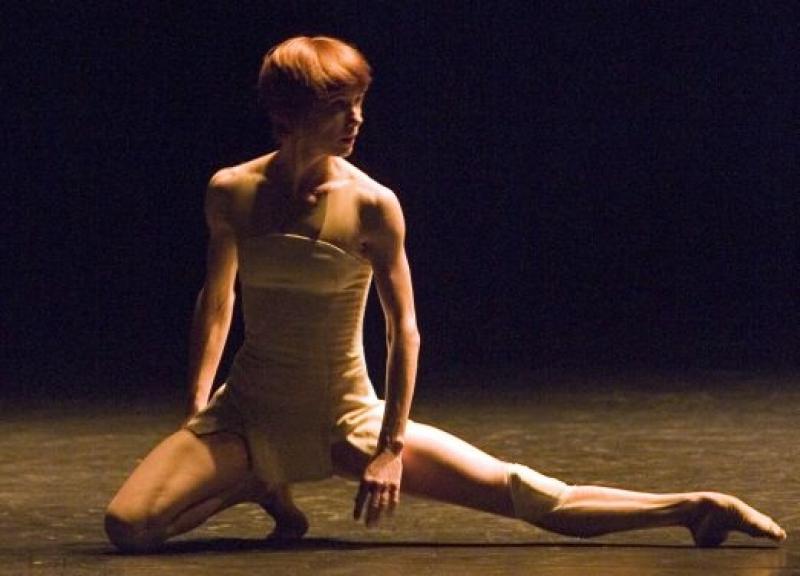
Not many of lady can use this shoes,,
Lucky!! That u were born to be a lady,cause there's no men can use this shoes..
Standing or Dancing with this shoes,,isn't as easy as you think,,
really you will feel the suffered,but you'll proud and feel the truth soul of Ballet..
you can get this shoes if you have already gotten a high level..
that level is pre intermediate level,,
pre intermediate level is a level after grade 8 (romantic level),,
Now,,in this chance..
I want to tell you about this beautiful shoes..
which every ballerina usually want it..
 A pointe shoe is a type of shoe worn by ballet dancers when performing pointework. Pointe shoes developed from the desire for dancers to appear weightless and sylph-like and have evolved to enable dancers to dance on the tips of their toes (i.e., en pointe) for extended periods of time. They are manufactured in a variety of colors, most commonly in shades of light pink.
History of Pointe Shoe
Women began to dance in ballet in 1681, twenty years after King Louis XIV of France ordered the founding of the Académie Royale de Danse. At that time, the standard women's ballet shoe had heels. Mid-18th century dancer Marie Camargo of the Paris Opéra Ballet was the first to wear a non-heeled shoe, enabling her to perform leaps that would have been difficult, if not impossible, in the more conventional shoes of the age. After the French Revolution, heels were completely eliminated from standard ballet shoes. These flat-bottomed predecessors of the modern pointe shoe were secured to the feet by ribbons and incorporated pleats under the toes to enable dancers to leap, execute turns, and fully extend their feet.
The first dancers to rise up on their toes did so with the help of an invention by Charles Didelot in 1795. His "flying machine" lifted dancers upward, allowing them to stand on their toes before leaving the ground. This lightness and ethereal quality was well received by audiences and, as a result, choreographers began to look for ways to incorporate more pointework into their pieces.
As dance progressed into the 19th century, the emphasis on technical skill increased, as did the desire to dance en pointe without the aid of wires. When Marie Taglioni first danced La Sylphide en pointe, her shoes were nothing more than modified satin slippers; the soles were made of leather and the sides and toes were darned to help the shoes hold their shapes. Because the shoes of this period offered no support, dancers would pad their toes for comfort and rely on the strength of their feet and ankles for support.
The next substantially different form of pointe shoe appeared in Italy in the late 19th century. Dancers like Pierina Legnani wore shoes with a sturdy, flat platform at the front end of the shoe, rather than the more sharply pointed toe of earlier models. These shoes also included a box—made of layers of fabric—for containing the toes, and a stiffer, stronger sole. They were constructed without nails and the soles were only stiffened at the toes, making them nearly silent.
Construction

The box is a hard enclosure within the front end of the shoe that encases and supports the dancer's toes. The front end of the box is flattened so as to form a platform upon which the dancer can balance, and fabric covers the exterior of the box for an aesthetically pleasing look. Some dancers take the satin off of their boxes to make the shoe less slippery

2. Sole
In most pointe shoes, the sole is constructed from a single piece of leather that is attached to the shoe with adhesive and reinforced by stitching along its edges. The sole overlaps and secures the unfinished edges of the shoe's exterior fabric. Pointe shoes may be manufactured with either scraped soles, which provide superior traction, or buffed soles, which have a smoother surface for reduced traction. Aesthetic appearance is of paramount importance for modern pointe shoes. To achieve an elegant appearance, the shoe's more decorative outer fabric is prominently featured, covering the maximum possible area of the shoe's visible surfaces.

3. Shank
Shanks are typically made from leather, plastic, cardstock, or layers of glue-hardened burlap. The flexibility of a shank is determined by its thickness and the type of material used. A shank's thickness may be consistent throughout or it may vary along its length to produce different strengths at select points. For example, slits may be cut across a shank at demi-pointe to enhance roll through. Also, a shank's thickness may transition at some point along its length in order to implement differing strengths above and below the transition. Standard pointe shoes typically have a full shank, in which the shank runs the full length of the sole, or fractional (e.g., half or three-quarter) length shanks.

4. Ribbons and Elastic Band
A pointe shoe employs two fabric ribbons and an elastic band to secure it to the foot. Most of the work of securing shoes to feet is done by the ribbons. The two ribbons wrap around the dancer'sankle in opposite directions, overlapping one another so as to form a cross at the front. The ends are then tied together in a knot, which is then tucked under the ribbon on the inside of the ankle to hide it from view. The ends of the ribbons are never tied in a bow, as a bow knot might not hold together reliably. The elastic band—which traverses the front of the ankle below the ribbons—keeps the heel of the shoe in place against the foot when the dancer is en pointe.
Accessories
 |
| Toe Spacers |
 |
| Toe Pads |
After a pointe shoe is broken in, it is common that the toe box still does not provide a comfortable fit for the dancer's en pointe foot. To mitigate the discomfort caused by the unyielding box, dancers will often wear toe pads, which are most often fabric-covered gel pads that encapsulate and cushion the toes. Also, gel toe spacers are sometimes inserted between the toes to provide cushioning and to adjust toealignments. But too much padding can be bad for the foot because if the box becomes too tight it can create deformation of the toes, corns, blisters, and even cause injury.
In addition to or in lieu of toe pads, some dancers may apply tape to their toes to reduce chafing and the likelihood of blisters. Lambswool is also used for this purpose by stretching it and wrapping it around the toes; after several such uses the lambswool becomes dense and custom fitted to the dancer's foot.
Colors of the Pointe Shoes

Okk,,see u at the next post
it will more greatfull and more interesting
and make you,my readers want to know more and more..
see you soon..
keep your soul of dancing!!
^^
HTML Comment Box is loading comments...